
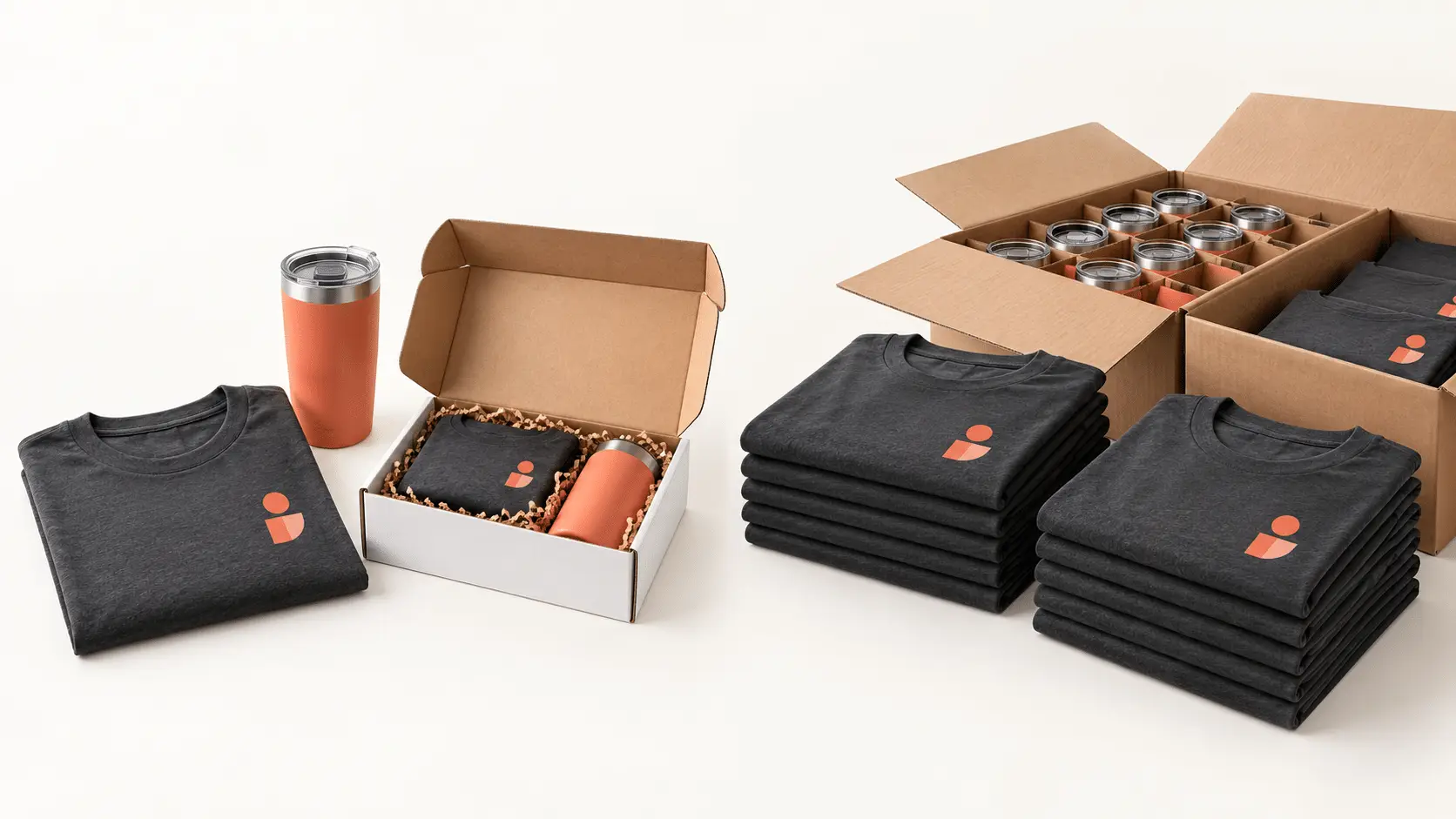
Choosing print-on-demand vs bulk ordering for company merchandise comes down to demand, total cost, employee choice, and delivery deadlines.
Use print-on-demand when demand is uncertain, employees order throughout the year, or you want to avoid holding finished inventory. Use bulk ordering when quantities are predictable and you can distribute the merchandise before it becomes outdated. A mix of both can work well: keep proven essentials in stock and offer other items on demand.
The right choice depends on more than the price of a shirt. You also need to account for storage, shipping, staff time, delivery dates, and products that never get used.
Here’s how to choose an ordering model for your company merchandise program.
Print-on-Demand vs Bulk Ordering: What Is the Difference?
Print-on-demand means an item is decorated after someone orders it. Bulk ordering means you purchase a batch of decorated products before distributing them.
Both models can support an employee company store. The difference is when you commit money to finished merchandise.
| Factor | Print-on-demand | Bulk ordering |
|---|---|---|
| When items are decorated | After an order is placed | Before individual distribution |
| Upfront inventory purchase | Usually lower; terms vary | Required for the batch |
| Cost per item | Often higher at small quantities | May decrease at larger quantities |
| Finished inventory | Less inventory to manage | Requires storage and stock tracking |
| Employee choice | Can support more options without stocking each variation | Limited to the styles and sizes purchased |
| Delivery timing | Includes production time after ordering | Stocked items can ship without a new production run |
| Main risk | Production delays or blank-product availability | Leftover, outdated, or incorrectly sized stock |
| Common uses | Ongoing employee orders and testing new products | Events, planned campaigns, and predictable demand |
Ask vendors to explain their model clearly. Some “on-demand” programs still require minimum orders, prepaid inventory, or other commitments.
When Does Print-on-Demand Make Sense for Company Merchandise?
Print-on-demand is useful when you don’t know exactly what people will order or when they will need it.
Instead of guessing how many medium hoodies or extra-large polos to buy, you let employees choose from approved products.
Consider this model when:
- Employees join throughout the year.
- Teams work across several locations.
- You want to offer multiple styles and sizes.
- You are testing a new product or design.
- Your branding may change.
- You have limited storage space.
For example, a growing company might give new hires access to an employee apparel store. Each person chooses an approved item in their preferred size, and production begins after the order.
That reduces the need to predict every employee’s choice in advance.
However, print-on-demand still requires planning. Confirm product availability, decoration options, production times, and delivery expectations before adding an item to your store.
When Is Bulk Ordering the Better Choice?
Bulk ordering can work well when you have a clear quantity, a defined purpose, and enough time to produce and distribute the products.
A planned conference is a good example. If you need 300 matching tote bags at one location, buying a batch may be more practical than placing hundreds of separate orders.
Consider bulk ordering for:
- Trade shows and conferences.
- Scheduled company events.
- Team uniforms with known requirements.
- Products employees consistently order.
- Merchandise that requires a minimum production quantity.
- Campaigns with confirmed recipient counts.
For apparel, collect sizes before placing the order whenever possible. A known headcount does not tell you which sizes people need.
Also decide who will store the products, manage distribution, and handle leftovers. Those tasks belong in the budget.
Is Bulk Ordering Always Cheaper Than Print-on-Demand?
No. Bulk ordering may lower the purchase price per item, but that does not always lower the cost per item actually used.
A discounted shirt provides little value if it stays in a box until the logo changes.
Compare the full cost of each option:
Total program cost = merchandise + setup and decoration fees + shipping + storage + fulfillment + staff time
Then calculate:
Cost per distributed item = total program cost ÷ items actually distributed
Here is a simplified example.
| Expense | Bulk order | Print-on-demand |
|---|---|---|
| Merchandise | 200 shirts × $12 = $2,400 | 150 shirts × $18 = $2,700 |
| Shipping, storage, and handling | $600 | $450 |
| Total cost | $3,000 | $3,150 |
| Shirts distributed | 150 | 150 |
| Cost per distributed shirt | $20 | $21 |
| Finished shirts remaining | 50 | 0 |
These figures are illustrative, not Axomo pricing or vendor quotes. They exclude taxes and assume comparable products and decoration.
In this example, bulk ordering still costs less per distributed shirt. But the difference is smaller than the original $12 versus $18 comparison suggests.
The remaining 50 shirts could improve the bulk order’s value if employees use them later. If those shirts become outdated or are the wrong sizes, the company still paid for them.
Use your own order history and vendor quotes to make the comparison.
How Do Delivery Deadlines Affect the Decision?
Choose your ordering model around the date people need the merchandise in hand.
For print-on-demand, the timeline can include order processing, production, quality checks, and shipping.
For a bulk purchase, the initial batch also needs production time. Once finished stock is available, individual orders can move through picking, packing, and shipping without waiting for another decoration run.
Neither model guarantees faster delivery in every situation.
Before committing, confirm:
- When artwork must be approved.
- When quantities and sizes must be final.
- When production starts.
- Whether the estimate covers production only or delivery.
- How split shipments and unavailable products are handled.
- What happens if the order misses the required date.
If merchandise is tied to an event, share the event date and destination before requesting a quote. Build in time to check the shipment and correct problems.
Which Model Gives Employees More Choice?
Print-on-demand can make it easier to offer a range of approved styles without buying finished stock in every size and color.
Bulk programs can also offer choice, but each stocked variation adds another inventory decision.
For example, three shirt styles in four colors and eight sizes create 96 possible combinations. You do not have to stock all of them, but every additional option makes forecasting more complex.
Start with a focused selection:
- A small number of useful products.
- Approved colors that work with your logo.
- Clear sizing information.
- Decoration options you have reviewed.
- Prices that fit the employee allowance.
For a broader setup checklist, read How Do You Set Up an Online Company Apparel Store for Employees?.
How Can You Keep Branding Consistent With Either Model?
Brand consistency comes from clear product and artwork rules.
For either ordering model, approve:
- The logo file and version.
- Logo placement and dimensions.
- Product colors.
- Decoration method.
- Artwork colors and any acceptable variation.
- Sample quality.
Bulk production can make it easier to review a batch together. Repeat orders still need checks because products, materials, and production conditions can change.
Print-on-demand requires the same attention to standards. Confirm how approved artwork is stored and how the vendor handles substitutions or unavailable products.
Order samples before a wider launch, especially when introducing a new garment or decoration method.
Can You Combine Print-on-Demand and Bulk Ordering?
Yes. A combined approach lets you match the ordering model to each product’s demand.
You might:
- Keep a proven onboarding item in stock.
- Offer optional apparel on demand.
- Buy event merchandise in a planned batch.
- Test new designs on demand before stocking them.
For example, an HR team could hold a supply of standard welcome-kit items while letting new hires order their preferred apparel separately.
Be clear about delivery. If stocked products and made-to-order apparel ship separately, explain that before checkout.
Review the mix as demand changes. A product with steady orders may become a good stocking candidate. An item that rarely moves may be better offered on demand or removed.
What Should You Ask a Merchandise Vendor Before Choosing?
Ask vendors to price the same real use case so you can compare the complete service.
Instead of asking only, “What does a branded hoodie cost?” describe the program:
“We have 250 employees across several locations. New hires order throughout the year, and we also need merchandise for two annual events. How would you handle ordering, production, storage, budgets, and delivery?”
Then ask:
Which products can be ordered individually?
Confirm minimum quantities by product and decoration method.What inventory must we purchase upfront?
Clarify ownership, storage charges, and any prepaid commitments.What is included in the quote?
Ask about setup, decoration, packaging, picking, shipping, and platform fees.How are employee orders managed?
Review access, approved products, allowances, and delivery-address collection.What happens when a product becomes unavailable?
Establish approval rules for substitutions.How are defects, sizing issues, and returns handled?
Confirm the policy for decorated merchandise before employees order.What reporting will we receive?
Ask how you can review spending, orders, and remaining inventory where applicable.
Written answers make the options easier to compare and reduce surprises after launch.
How Do You Choose the Right Model for Your Company?
Start with demand, deadlines, and the cost of unused inventory.
| Your situation | Model to evaluate first |
|---|---|
| You are testing a new product | Print-on-demand |
| Employees order at unpredictable times | Print-on-demand |
| You have confirmed quantities for an event | Bulk ordering |
| One product has steady, repeat demand | Bulk ordering or a combined approach |
| You need employee choice plus stocked essentials | A combined approach |
| You have a firm delivery deadline | Compare confirmed production and fulfillment timelines for both |
You do not need one rule for every product.
Use actual order data to decide what deserves shelf space, what can be made after ordering, and what your team no longer needs.
What Questions Do Teams Ask About Print-on-Demand and Bulk Ordering?
Does Print-on-Demand Mean There Are No Minimum Orders?
Not always. Minimums depend on the product, decoration method, and vendor. Confirm the requirements for each item rather than assuming the entire catalog supports single-item orders.
Is Print-on-Demand Better for the Environment?
It can reduce unused finished merchandise by producing items after orders are placed. However, materials, decoration, packaging, transportation, and product use also affect environmental impact. Neither model is automatically the better choice in every case.
Can Bulk Merchandise Be Shipped to Employees’ Homes?
Yes, if your vendor or fulfillment provider offers individual delivery. Include picking, packing, address collection, and shipping costs when comparing options.
Should You Stock Every Size of Employee Apparel?
Base that decision on demand and service needs. Employee size collection, order history, and on-demand options can help reduce guessing. Review the vendor’s exchange policy before choosing how much stock to hold.
How Often Should You Review Merchandise Inventory?
Set a regular review schedule based on order volume. Check stock before major events, new-hire campaigns, and branding changes. Review slow-moving products before placing another order.
How Can Axomo Help You Manage Company Merchandise?
Axomo brings approved merchandise into a company store where employees can choose products and submit orders. Its company-store tools also support employee credits, fixed or recurring budgets, shipping, and reporting. Axomo.com
Start by identifying which products you need, who will order them, and when they must arrive. Then confirm the production and fulfillment options available for those products.
Explore Axomo company stores or schedule a demo to discuss your merchandise program.